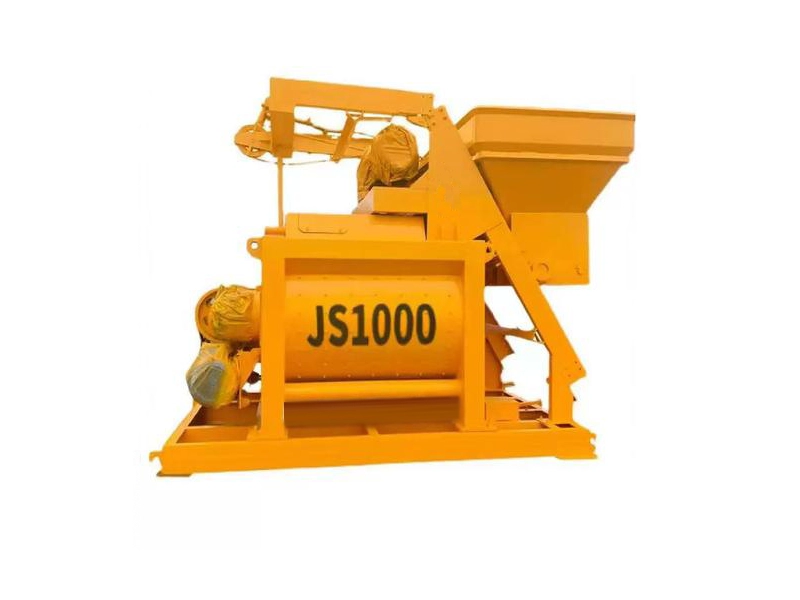
The JS1000 double horizontal axis forced concrete mixer consists of feeding, mixing, unloading, water supply, electrical, cover, chassis, leg gears, and other parts. The JS1000 concrete mixer is a spiral belt structure composed of two mixing blades on two mixing shafts, which creates a three-dimensional mixing effect along the radial and axial directions. It can comprehensively push, rub, and squeeze materials, achieving high uniformity mixing effect in a short time and low energy consumption. Suitable for mixing plastic, dry hard, lightweight aggregate concrete and various mortars and mortars.
1. Excellent mixing quality and good uniformity
The mixed concrete slurry is uniform and does not exhibit segregation or raw material phenomenon, ensuring the stable and consistent quality of each batch of concrete.
2. High production efficiency and short work cycle time
Rapid mixing: The forced mixing method is much more efficient and has a shorter mixing time than the self falling method. The mixing cycle for a typical batch of material is between 60-90 seconds, which can ensure efficient output for continuous production.
Strong continuous operation capability: As the core of the mixing plant, it can seamlessly connect with precise batching systems and efficient conveying systems, achieving automated continuous production and greatly improving the efficiency of the entire concrete production line.
3. Reasonable structural design and high reliability
Double horizontal axis design: The linear velocity of the blades on the two mixing shafts has been optimized to form a complex composite motion, making the mixing more free of dead corners, while the load distribution is more uniform and the operation is smooth.
Sturdy box structure: The mixing tank is usually welded from high-strength steel plates, which can withstand long-term severe mixing impact and wear, and has a long service life.
Advanced shaft end sealing technology: This is the key technology for forced mixers. JS1000 usually adopts a multiple sealing structure (such as floating seal+oil seal), which can effectively prevent mortar leakage into the bearings, protect the core transmission components, greatly improve the reliability and durability of the equipment, and reduce maintenance costs.
4. Unloading quickly and cleanly
Large opening discharge door: usually driven by hydraulic or pneumatic, it opens quickly and closes tightly.
Fast unloading speed: Generally, 1 cubic meter of material can be unloaded in 10-15 seconds, shortening the working cycle.
Low residual discharge rate: The special design of the mixing blades and pot body makes the discharge very clean, reducing mixing between different batches of concrete and facilitating cleaning.
5. Good wear resistance and relatively low maintenance costs
Wear resistant treatment of key parts: Vulnerable parts such as mixing blades and lining plates are cast with high chromium alloy wear-resistant materials, which have excellent wear resistance and long service life.
Modular design: Many brands of JS1000 adopt modular design, which makes it very convenient to replace vulnerable parts such as liners and blades, reducing downtime for maintenance.
6. High degree of automation integration
JS1000 is the standard host for modern fully automatic mixing plants, and its electrical control system can be perfectly integrated into the central control system of the entire mixing plant, achieving precise timing control, fault alarm, and safety interlocking. It is the foundation for achieving intelligent and unmanned operation and production.